What Does “Kilo” Mean? Metric Prefixes Explained
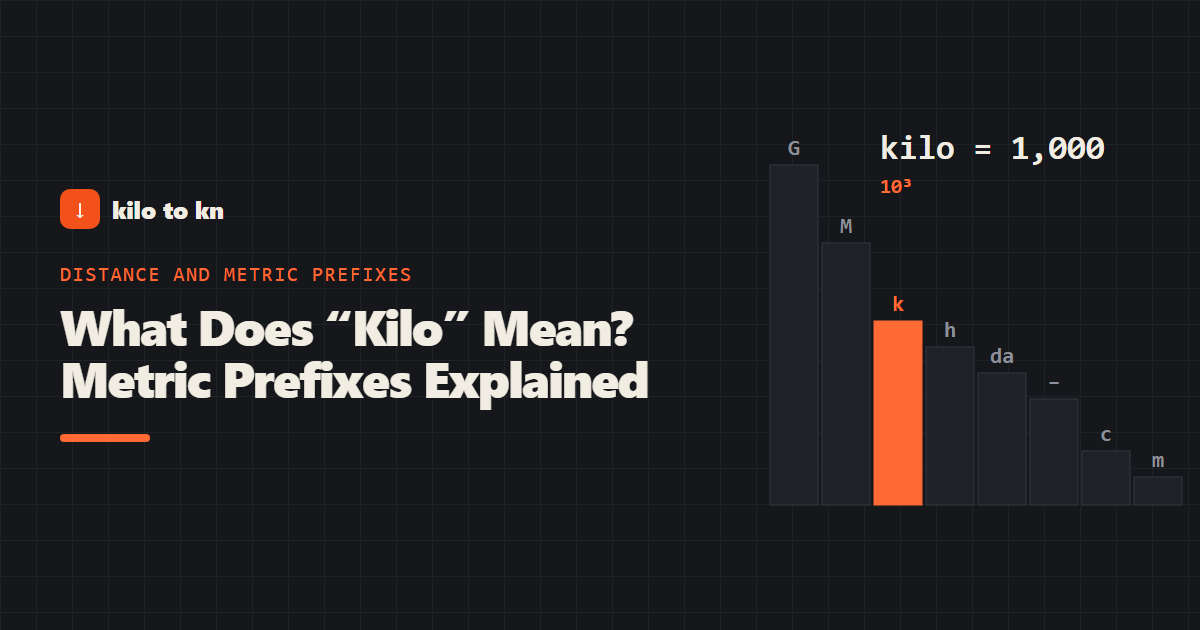
Kilo means one thousand (1,000, or 10³). Put kilo- in front of a unit and the unit becomes 1,000 times larger: a kilogram (kg) is 1,000 grams, a kilometre (km) is 1,000 metres and a kilowatt (kW) is 1,000 watts.
Kilo is one of 24 prefixes in the International System of Units (SI). Its symbol is a lowercase k.
The 10 Most-Used Metric Prefixes
The SI has 24 prefixes, from quecto (10⁻³⁰) to quetta (10³⁰). 10 prefixes cover nearly every everyday unit:
| Prefix | Symbol | Factor | Example |
|---|---|---|---|
| giga | G | 1,000,000,000 (10⁹) | 1 GW = 1,000,000,000 W |
| mega | M | 1,000,000 (10⁶) | 1 MN = 1,000,000 N |
| kilo | k | 1,000 (10³) | 1 kg = 1,000 g |
| hecto | h | 100 (10²) | 1 hm = 100 m |
| deca | da | 10 (10¹) | 1 dam = 10 m |
| deci | d | 0.1 (10⁻¹) | 1 dL = 0.1 L |
| centi | c | 0.01 (10⁻²) | 1 cm = 0.01 m |
| milli | m | 0.001 (10⁻³) | 1 mm = 0.001 m |
| micro | µ | 0.000001 (10⁻⁶) | 1 µm = 0.000001 m |
| nano | n | 0.000000001 (10⁻⁹) | 1 nm = 0.000000001 m |
Each step from kilo down to milli is a factor of 10 or 1,000. Kilo to centi is 5 steps of ×10, so 1 km = 100,000 cm.
7 Common Units with the Kilo Prefix
Kilo appears in 7 units most people meet every week:
- Kilogram (kg): 1,000 grams of mass.
- Kilometre (km): 1,000 metres, or 0.621 miles.
- Kilowatt (kW): 1,000 watts of power, or 1.34 horsepower (hp).
- Kilowatt-hour (kWh): 1,000 watt-hours of energy, the unit on electricity bills.
- Kilojoule (kJ): 1,000 joules of energy, the unit on many food labels.
- Kilonewton (kN): 1,000 newtons of force, the weight of about 102 kg.
- Kilopascal (kPa): 1,000 pascals of pressure, the unit on many tyre gauges.
Where “Kilo” Comes From
Kilo comes from the Greek khilioi, meaning thousand. The French metric system adopted kilo- in 1795, along with hecto- and deca- from Greek and deci-, centi- and milli- from Latin. Greek prefixes made units larger, and Latin prefixes made units smaller.
The General Conference on Weights and Measures (CGPM) added the newest 4 prefixes in 2022: ronna, quetta, ronto and quecto.
How to Write the Kilo Symbol
The SI rules give 3 points for the kilo symbol:
- Lowercase k. Uppercase K is the kelvin (K), the unit of temperature, so “Kg” and “KM” are wrong.
- No space inside the unit. Write kg, km, kN.
- One prefix only. Write mg, not µkg, even though the kilogram is the base unit.
Kilo in Computing: 1,000 or 1,024?
A kilobyte (kB) is 1,000 bytes in SI usage. Computer memory has long used “kilobyte” for 1,024 bytes (2¹⁰), so the International Electrotechnical Commission (IEC) created the kibibyte (KiB) in 1998 for 1,024 bytes.
Storage makers label drives in SI units (1 TB = 10¹² bytes). Operating systems such as Windows report sizes in binary units, so a 1 TB drive shows about 931 GB.
Questions
What does the k in kg stand for?
The k stands for kilo, meaning 1,000. A kilogram is 1,000 grams.
Is kilo always lowercase k?
Yes, the SI symbol for kilo is lowercase k. Uppercase K is the kelvin, the SI unit of temperature.
What is bigger than kilo?
Mega (10⁶) is the next prefix above kilo, followed by giga (10⁹) and tera (10¹²).